
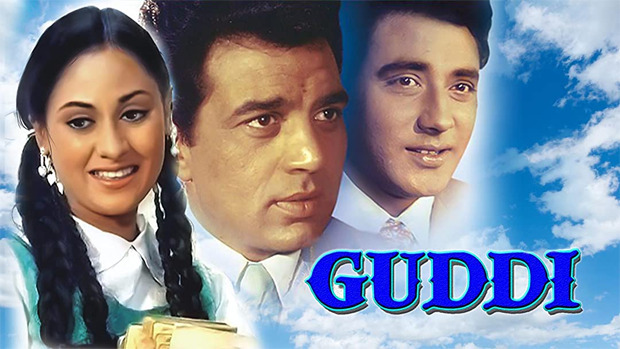
The role of Guddi—wide-eyed, dreamy, and caught between fantasy and reality—became a cultural touchstone in Indian cinema. Jaya Bachchan’s portrayal in Guddi (1971) is now iconic, etched into the nation’s cinematic memory. But few know the role almost didn’t go to her. Before Jaya brought Guddi to life, another actor was initially signed—someone far from the innocent schoolgirl image. The original choice? Bollywood action star Dharmendra.
Yes, the same Dharmendra known for rugged charm and heroic swagger was first approached to play the titular character in a film about a girl obsessed with films and stardom. The twist seems absurd now—but it reveals how deeply misunderstood the film’s vision was in its earliest stages.
The Misconception That Sparked a Casting Revolution
At first glance, signing Dharmendra for Guddi sounds like a punchline. But the decision wasn’t as random as it appears. Director Hrishikesh Mukherjee was known for subverting expectations, and early outlines of the film were more experimental. The original concept leaned into meta-commentary—what if a male fan became obsessed with a female star? The gender-flipped narrative was brainstormed as a satire on fandom, hero worship, and the illusion of stardom.
Dharmendra, already a rising superstar in the late 1960s, was considered ideal. He had the fame, the fan following, and the ability to portray both vulnerability and bravado. Studio executives believed his name alone would guarantee box office traction. But Mukherjee soon realized the satire would lose its emotional core with a male lead. A young girl’s obsession with cinema carried deeper social weight—her dreams reflected the aspirations of millions of Indian women navigating tradition and modernity.
The shift from Dharmendra to a fresh female lead wasn’t just a casting change—it was a philosophical pivot.
Why the Role Needed a Real Guddi, Not a Star
Casting a seasoned male star would’ve turned Guddi into a parody. What made the film resonate was authenticity. Guddi wasn’t just chasing fame—she was navigating identity, innocence, and the collision between reel and real life. To pull that off, the lead needed to feel genuine, unpolished, and emotionally accessible.
This is where Jaya Bachchan entered the picture—though “entered” undersells the chaos of her casting. She wasn’t a newcomer, but she was far from a bankable star. A student at FTII (Film and Television Institute of India), Jaya was still figuring out her career. Her prior roles were limited, and she had no major commercial hits.
Mukherjee saw something others didn’t: a natural expressiveness, a lack of artifice. When he met her, he wasn’t evaluating star power—he was watching for the flicker of wonder in her eyes. He tested her with improvisational scenes—asking her to react to imagined fan letters, to mimic her favorite actresses, to describe her first film experience. Jaya didn’t perform—she lived the moments.
That raw authenticity became the soul of Guddi.
Dharmendra’s Near-Miss and the Irony of Fate
Ironically, Dharmendra didn’t vanish from the project entirely. Once the decision was made to cast a female lead, Mukherjee brought him back—in a pivotal cameo. He played himself, the matinee idol Guddi idolizes from afar. This brilliant meta-casting turned Dharmendra into both the object of obsession and a grounding force in the film’s second half.
When Guddi finally meets “Dharmendra,” the illusion cracks. He’s kind, but ordinary. He eats, jokes, and sweats like anyone else. The scene where he serves her tea in a simple cotton shirt dismantles the fantasy. It’s one of the most powerful moments in the film—not because of spectacle, but because of humility.
Had Dharmendra played Guddi, this moment would’ve lost its meaning. The power came from contrast: the star and the fan, the real and the imagined. Mukherjee’s casting reversal didn’t just fix a flawed idea—it elevated the film into something timeless.
The Ripple Effect on Bollywood Casting
Guddi marked a turning point. It proved that authenticity could trump star power. Jaya’s performance earned critical acclaim and launched her into the upper echelon of actresses. It also signaled a shift in how directors approached casting—especially for roles rooted in realism.
Before Guddi, studios prioritized name recognition. After Guddi, filmmakers began seeking actors who became the role, not just played it. This opened doors for actors like Shabana Azmi, Smita Patil, and later, Konkona Sen Sharma—performers whose strength lay in emotional truth, not box office numbers.
Even commercial cinema felt the ripple. Directors like Basu Chatterjee and Gulzar began casting against type, favoring nuance over glamor. The “girl next door” archetype—once a cliché—gained depth thanks to performances like Jaya’s in Guddi.
Common Misconceptions About the Casting of Guddi
Despite the film’s legacy, myths persist:
- Myth 1: Jaya Bachchan was the first and only choice.
- Reality: She was a late entrant after the male-led concept was scrapped.
- Myth 2: Dharmendra was upset about being replaced.
- Reality: He later called his cameo one of his most meaningful appearances.
- Myth 3: The film was always intended as a coming-of-age story for a girl.
- Reality: The original script was gender-ambiguous and more satirical.
- Myth 4: Jaya was discovered on the street.
- Reality: She was trained at FTII and had already acted in small roles.
Understanding these myths matters—it shows how creative decisions evolve under pressure, ego, and vision.
Why This Casting Story Still Matters
Today, casting directors rely on data, social reach, and algorithmic popularity. Stars are chosen based on Instagram followers, not emotional range. In that context, the Guddi story feels radical. It reminds us that great casting isn’t about who’s trending—it’s about who fits.
Imagine Guddi with a glamorous, established actress. The innocence would’ve felt staged. The transformation forced by disillusionment wouldn’t land. Jaya wasn’t playing a character—she was channeling a generation’s quiet rebellion.
And imagine Dharmendra in drag, playing a schoolgirl. While it might’ve sparked curiosity, it would’ve reduced the film to a gimmick. The emotional truth would’ve evaporated.
The lesson? Vision trumps convenience. When casting feels risky, that’s often a sign you’re on the right track.
What Filmmakers Can Learn from the Guddi Casting Decision For aspiring directors and casting agents, the Guddi story offers practical takeaways:
- Test for authenticity, not just skill
- Mukherjee didn’t hold a traditional audition. He looked for genuine reactions—something workshops and improvisation can reveal better than scripted scenes.
- Be willing to pivot
- The shift from a male lead to a female protagonist wasn’t easy. It meant rewriting scenes, rethinking marketing, and risking studio backlash. But it was necessary.
- Use stars as tools, not crutches
- Dharmendra’s cameo worked because it served the story. Today, many films cast stars in pointless cameos for buzz. Guddi shows how to use fame meaningfully.
- Look beyond experience
- Jaya had no major hits. But her training at FTII gave her tools most commercial actors lacked. Talent pools like drama schools or regional theatre are underutilized resources.
- Let the character guide the casting, not the budget
- Studios wanted a known name. Mukherjee wanted the right name. He won—and the film gained immortality.
The Legacy of a Nearly Wrong Choice
The fact that Dharmendra was first signed to play Guddi isn’t a trivia footnote—it’s central to the film’s legacy. It highlights how close art comes to being compromised. One stubborn decision, one ego-driven casting, and Guddi could’ve been forgotten.
Instead, it’s studied in film schools, referenced in modern cinema, and revered for its emotional honesty. Jaya Bachchan’s performance remains a benchmark. And Dharmendra’s brief appearance is now iconic—a star humbling himself to serve a greater story.
The near-miss casting reminds us that greatness often emerges from course correction. It’s not about getting it right the first time. It’s about having the courage to admit when you’re wrong—and the vision to fix it.
If you're casting a film today, ask yourself: Are you choosing for safety or for truth? Are you hiring a name—or a soul? The ghost of Dharmendra-as-Guddi lingers as a warning: even the biggest stars can’t save a misaligned vision.
But a single right choice—a Jaya Bachchan, raw and real—can change cinema forever.
FAQ
Who was originally cast to play Guddi? Dharmendra was initially signed to play the lead role, though the character was reimagined as female before production.
Why was Dharmendra replaced in Guddi? The director realized the story needed a female lead to authentically explore themes of fandom, gender, and identity.
Did Dharmendra appear in the final film? Yes—he played a cameo as himself, the film star idolized by the protagonist.
How did Jaya Bachchan get the role of Guddi? She was selected after Hrishikesh Mukherjee saw her potential during auditions that focused on emotional authenticity.
Was Guddi Jaya Bachchan’s first major film? No—she had acted before, but Guddi was her breakthrough performance that established her as a leading actress.
What made Jaya Bachchan’s performance in Guddi special? Her natural expressiveness, lack of theatricality, and ability to convey innocence and internal conflict resonated deeply with audiences.
How did the casting of Guddi influence Bollywood? It shifted focus from star-driven casting to performance-driven choices, paving the way for more realistic, character-centered films.
FAQ
What should you look for in Who Was First Signed to Play Guddi in the Iconic Film?? Focus on relevance, practical value, and how well the solution matches real user intent.
Is Who Was First Signed to Play Guddi in the Iconic Film? suitable for beginners? That depends on the workflow, but a clear step-by-step approach usually makes it easier to start.
How do you compare options around Who Was First Signed to Play Guddi in the Iconic Film?? Compare features, trust signals, limitations, pricing, and ease of implementation.
What mistakes should you avoid? Avoid generic choices, weak validation, and decisions based only on marketing claims.
What is the next best step? Shortlist the most relevant options, validate them quickly, and refine from real-world results.


